Thursday, February 12, 2015

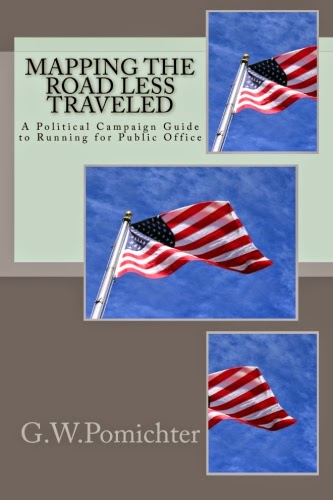
"Mapping the Road Less Traveled" : Why People Run for Office

 Before beginning, it is important that both the candidate and campaign team have a clear understanding of the process in which they are entering, and they have a sincere desire, with this understanding, to proceed.
Campaigning for public office requires focus and determination, and it can stress both financial and emotional resources. After suffering these trials, winning candidates earn the privilege of holding a demanding and very public profession in politics.
One political analyst humorously described this profession, saying, “It is a profession in which the name is very telling.” He went on to explain, “The word can be taken in two parts: Poly, meaning many; and tics, meaning blood sucking animals.”
So, why do people choose to endure these rigors?
Political science experts define politics as “the struggle or competition for power.” But the reason many seek public office is in the finer points of that broader definition. To understand what motivates these unique individuals, we must begin by understanding what political power is, and how it can be used.
Political power can be best defined as the ability to influence or control the behaviors of others. This power can be obtained only by first obtaining the consent of those over whom power is wielded. The United States’ historical “Declaration of Independence” notes that governments “derive their just power through the consent of the governed.” History reminds one that consent and power can be gained through a variety of methods, including force of arms, inherited authority and, in a democratic republic such as that in the United States, through an electoral process.


Understanding what power consists of and how it is attained is only the beginning, though. More often than not, candidates are motivated by the specific uses of this power within a given social structure. For example, a candidate may perceive the political structure itself as problematic and wish to use the power that accompanies campaign victory to alter that structure — to change the system itself.
Candidates for municipal or county offices may want to improve the level of local police or fire service, while candidates for state legislative offices may be more interested in affecting broader social policies such as making changes to state laws or improving schools. Some federal candidates may want to work to improve national defense or implement more global social policies such as meeting national medical needs. And while campaigning, at one time or another, almost all say they will reduce waste and make government more efficient.
The U.S. political structure has been designed to accommodate all of these uses of political power. Its stated faith in the principal of self governance as well as in the citizen lawmaker opens the door for a diverse group of people to participate in the process, bringing with them a wide variety of expertise in many subject areas. Throughout American history, this diversity has often put the right expertise in a position to respond to some of the world’s most challenging problem.
Despite the many reasons candidates choose to seek office and to compete for power, one thing that most candidates have in common is that they prefer studying government policy over political campaigning. For this reason, the jobs of candidate and elected official differ greatly and the tools used by the former must be sound in order to achieve the later. Regardless of what motivates a candidate, there are some universal tools that campaigns can use to ensure that any citizen, with sufficient interest in affecting public policy, can wield the power needed to affect change within a given social group by becoming an elected official.

General Knowledge:

Candidates entering public service should always have a general knowledge of public service and of the community they wish to serve.  This knowledge can be most easily categorized in three areas: District/Local knowledge, Office/Service Knowledge and Current Events Knowledge.

District/Local

A candidate who wishes to serve in elected office should have a working knowledge of the district or geographic area they wish to serve.  This knowledge consists of more than the numeric data that the campaign will use to target voters.  It should most effectively consist of a knowledge of local landmarks, large commercial or business interests and industries and a familiarity with geo-political and social attitudes.  For instance, a candidate whose geographic area includes multiple airports or an aircraft manufacturing company, and whose constituents may be largely employed by these entities may benefit from knowledge of aviation terms or industry concerns.  Likewise, a candidate whose constituency includes large numbers of union members or rural farmers, should have a working knowledge of the top concerns of these very divergent social groups.

Office/Service

A candidate wishing to serve in any elected office that sets or contributes to public policy should be well versed in the office and level of participation in which they will, if successful, be party to.  If, for example, a legislator is to be responsible for voting on or producing local, state or even federal budget issues, it is wise for a candidate to become as familiar as possible with the most recent budget for the particular government entity.  Similarly, a candidate who might be asked to vote upon local zoning changes or business licensing, might study past and recent decisions about these issues made by the government upon which the candidate is asking to serve.  This familiarity will help the candidate to avoid dramatic promises they might not be able to keep from the office they seek.  It will further set a candidate apart from a less informed or knowledgeable opponent.

Current Events:

While candidates are most often and reasonably interested in events and activities that are subject to the office they seek, it is a mistake not to have a basic grasp of current events at other levels of influence.  In fact, national or state trends often play a vital role in shaping a particular population’s perspective of local events.  For this reason, candidates should familiarize themselves daily with the happenings that are most talked about or might affect these perceptions.   As is expected of any person seeking public office, candidates should develop opinions about these issues, but should be wary of posting, publishing or otherwise promoting these opinions publicly, as a candidates position on issues that are not affected by the office being sought, can impact one’s election to that office.  Instead, carefully thought out opinions about current events, which are consistent with the campaign’s message should be prepared, and only referred to when solicited.

Understanding Campaign Laws


While America’s most visible political campaigns are often governed by federal laws and guidelines, such as those that limit contributions to congressional candidates, or define Political Action Committees and regulate Presidential candidates, most of the laws that govern elections are made at the state level.
The U.S. Constitution very specifically delegates the role of officiating elections to each state, and as such laws that pertain to most elections are made and enforced in the state where an election is held. 
These state laws can govern everything from the amount of money a campaign may receive, or an individual or company or political entity may contribute to the exact language that must be present in political advertising disclaimers.  
The chief source of information with regard to political election laws is often the state’s Department of State, Division of Elections, Board of Elections or other state election officials.  Since each state is different, all candidates and campaign staffers are encouraged to research the laws specific to a candidate’s state.
Federal laws responsible for further governing the election of members of both houses of congress and the executive branch are best accessed through the Federal Election Commission or FEC as it is commonly referred. 
Campaigns for higher state or federal office should consider retaining legal counsel with election law experience when circumstances allow.
Find out more:  Get "Mapping the Road Less Traveled" by G.W. Pomichter at Amazon.com TODAY!


Wednesday, February 4, 2015

Apple Users Get Lucky in iTunes Store for iBooks

Author G.W. Pomichter is pleased to announce the release of his novel, “Lucky" in the iTunes store for Mac, iPhone, iPod, and iPad users.

https://itunes.apple.com/us/book/id887459004


“Luckyis an homage to a by-gone era of classic "Detective Noir" stories is a fun and exciting journey through the streets of L.A. in 1945. Lucky is returning home from World War II to restart his life up as a L.A.P.D. cop, when a case nobody wants lead him on a journey of self discovery he will never forget. Love, lust, and lamentation, travel beside Lucky through intrigue, mystery and murder, all conspiring to turn a hero into another gritty L.A. shamus reminiscent of Sam Spade or Philip Marlowe.

     Pomichter is a graduate of Eastern Florida State College and is a former writer and reporter for Hometown News in Melbourne, Florida. The graduate of Florida Air Academy is a former U.S. Army infantryman and long time lover of the classic detective “noir” genre.
     
     “This is a fun look at not only a unique time in modern history, but a fun and classic story telling style,” Pomichter said. “It presents a style of language and opportunity to describe familiar places in a more fantastical light.”

     “Lucky,” which is available online at notable book retail giant Amazon.com, revisits the 1940’s and the classic noir style made famous in films like “The Big Sleep” and the Humphrey Bogart classic “The Maltese Falcon.” “There is just something that captivates you when reading a gritty 1940's detective novel and this one didn't disappoint!” wrote Amazon reviewer “AJLove.” 

     Pomichter said he was delighted by the response.      “That is who you want to write for,” he said. “It’s for the readers. It’s to give them a short escape from the here and now. It’s great when you can help a reader do that.”

Get "Lucky" on iTunes TODAY!  

Sunday, January 25, 2015

ISIS and the Woodrow Wilson Connection

"Modern Conflicts of Interest and One Possible Confluence of Events"

Today, as the "Middle East" takes center stage in our modern discourse about war and warriors, one question often dominates our perspectives.  Why is this conflict?  

Modern millennial liberals blame former President George W. Bush's presumed over reach following the tragic Sept. 11 attacks of 2001.  Others, from the conservative "right" disregard this as an over reaction based on faulty intelligence and while touting the strategic successes of post 9/11 era, blame President Obama's less aggressive stances on foreign policy.  These views are often expressed by political ideologues who categorize this posture as apologetic.   Both perspectives may have merit.  But are either view points expressive of a cause to our current conflicts. 

Some might argue that ideological conflict between religious factions is to blame, and that as these differences harken back thousands of years, no solution is possible.  

But, sects of Islam as well as modern Christianity and Judaism have coexisted in this area in recent history. 
In fact, they did so during the existence of the last Middle Eastern Islamic Caliphate.  Most might know this as Ottoman Empire.

In fact, I purport that the fall of the Ottoman Empire following World War I might have predicated today's conflicts.  
Like other "Central Powers," the Ottomans were dissolved and the map redrawn following the allied victory in WWI.  The Caliphate that had existed for hundreds of years, was destroyed as the result of a poor choice of allies by the emperor and the resulting severity of consequences levied by European allies following their defeat of the Central Powers.  

Like most wars leading into the 20th century the underlying issues of the war were practical.  Economic expansion, the preservation of old and powerful aristocracies and growing nationalism, as well as a long period of peace that fed the glorious dreams of young warriors and leaders alike, were much the cause of the Great War.  But, as is the plight of the conquered, the blame for such an unprecedented loss of life was laid squarely on the defeated.  
It has been nearly 100 years since the end of WWI.  Civilized western society often points to the inequitable settlement of that war as a significant contributing factor in the  development of the resentments that precipitated World War II, and perhaps the rise of Hitler and his Nazi party which perpetrated the most heinous act of genocide in history. 

But could this same settlement of WWI be to blame for the 21st century Middle East conflicts?  

To answer this question, it is first necessary to take a wide view of the events of the past century, and a significant look at historical conflicts that predate our current era.  
To begin, it is important to remember that the wars that gave birth to the Ottoman Empire spanned more than a century themselves from the late 1200's until the mid 1400's, during which time the empire was carved up into smaller fiefdoms or nations.  The end of European crusades had left disparate factions and colonial powers.  Following the fourth crusades by Islamists into Eastern Europe which dealt the final blow to the Byzantine empire, establishing modern European Christendom yielded a Turkish dominant Sunni Islamic Caliphate throughout the once desperate Islamic world.

This, perhaps overly simplified explanation of the results of the Ottoman-Byzantine wars, does establish what would be for nearly 800 years a peace, all be it tenuous, between the West and Middle East.  In that time small pockets of the caliphate were colonized, plundered and abandoned, all while trilling no significant world wide footprint.  This went on just as many self contained European conflicts, as well as the American Revolution and the fledgling democracy's own civil war, and middle eastern politics played an arguably less significant world role than those two events.  

In the Early days of the Great War, the empire sided with the central powers.  Some scholars believe the goals of these powers and the early days of the war was to preserve the status quo.  While some can argue that this status quo, and the existing aristocracies that relied upon it were becoming antiquated as new political ideologies such as democracy, modern socialism and what would eventually become Russian communism amidst the Great War, struggled to gain ground.  It could, however, also be argued that this status quo held by that same aristocracy had been able to hold the lines of a religious and ideological war to a tenuous peace for 800 years, essentially ending the crusading days of the past.  It is arguably true that the end to crusading by the west allowed the enlightenment to occur, and gave purchase to a social evolution in which secular governments could in fact be built and established.  
Once WWI became global, and the Central powers were defeated, the powers of the modern world were able to fully embrace the new ideas.  Democratic socialism in Europe, Communism in Russia and China, and Democratic Capitalism in America and other places.  But, the loss of the war also meant growing resentments for the conquered.  

In Germany, the dictatorial Nazi party and its charismatic leader rose up in merely 2 decades.
In the Middle East, the Ottoman imperial territories,  however, once dissolved into smaller nations, new fiefdoms and left to return to ideological chaos between disparate factions, the results took longer to realize.  
These territories were treated in practice, if not formally, as little more than colonial territories rich with newly needed resources such as oil.  Tentative alliances were sought throughout WWII with the emerging states in the region by both Axis and Allied powers.  
While European refugees from the advancing WWII fallout spread around the globe, many European Jews, who for generations had little considered their cultural or hereditary roots in the Middle East, fled the genocide of the Nazis back to their biblical home land, fostering a new era of conflict in the long standing religious and cultural differences between Judaism and Islam.  This conflict, in its own right, has been difficult to accurately understand, as it predates an accepted recorded history and finds its roots in more etherial scriptures.  The only dissed able fact of it seems to be that Isreal does at present exist, and is in fact in varying states of conflict with its Islamic neighbors.  (This article will not speculate on moral justifications for or against this conflict.  I personally support the right of Israel to exist).

As WWII closed with the defeat of the Axis Powers, again the Allies set the world stage for a post war era, and they did so with a relatively dismissive view of the resource rich Middle East, instead carving up the globe with more recent or modern interests in mind.  The once mighty and united Ottomans, now almost forgotten when framed by the advent industrial history, were seen as less industrial or even "3rd world" interests to be only negotiated with for resources they held, but had seemingly little use for, as the modern Western world held the technologies that required these resources. 

Lacking the cohesive leadership of the empire, and feeling dismissed in the new era, the states of the former empire each in their own interests, and driven by internal strife between resident, Sunnis, Shiites, Jews, and Christians, as well as constant border disputes, made individual, though often temporary alliances with outside forces. 
Most of these alliances were in effect to avoid further colonizing by other powers, such as that attempted by Soviet Russia in the 1980's.  During this seeming scurrying for patron nations to assist in establishing solid and secure borders through the region, or broker tenuous peace between factions, the tactics of assimetrical tribal warfare begin to flourish in the far off deserts and isolated mountains.  

New leaders, born in the same resentment as the Nazis before them, yearning for the glorious days of imperial success, form religious and political armies similar to those of fading memory by the west. they find a poor, marginally preindustrial population with deep roots in their religion and desert cultural identity on which to prey.  
These groups, Al 'Queda  and most recently ISIS/ISIL, promise the return of Caliphate, the return of past glories in the name of prophets and if the creator.  It is the complete devolution of enlightenment ideals, and the return to the battle cries of nearly a millennium ago.  

To effectively set an expectation that the nations of this region join the modern era requires first that the "new world" acknowledge that by action, inaction or negligence, the concurrent development of the Middle East and its politics has been stifled for the past 100 years as a result of a the regions now ancestral participation as a Central Power of World War I.  

The question now remains, one of historical significance.  If the contributing factors to WWII could have been recognized, could the war, the rise of its leaders and the death it caused have been avoided?

Now, its implications realized: can it be avoided again?  
If not, and the result of the century long build up is to be another global war, is it best to prepare, pre-empt or await it?  

This article does not excuse the deplorable and despicable actions of ISIS-ISIL, or any other terrorist entity, nor does it imply blame for their deceit, destruction or hate.  It merely posits a series of limited observations about the historical context of current affairs.  

At its best, this is speculative observation based conjecture or a pseudo-intellectual rant.  

You decide.  


Tuesday, December 23, 2014

Do You Believe in Santa Clause?


Do you believe in Santa Clause?  Do you believe that the joy of seeing someone special revel in receiving that perfect gift is more important than the praise you might receive for having selected it?  Do you find in the selection of such a gift a rewarding feeling that washes over you filling you with joy, not at your selection, but rather at the knowledge that you have paid attention and truly know those with whom you spend your time?  Do you feel the overwhelming satisfaction of watching a child or loved one fill up with wonder and the whole light of happiness in accepting all the love that accompanies such a gift.  Is, in fact, your joy found in the giving of such love?

Do you believe in the anonymity that allows these tokens to be truly reveled in, without the expectation that conditioned responses of gratitude must accompany every gesture of good will?  Can you find the truest gratitude in the flickers of happiness behind a loved one's smile?  

If you were to close your eyes and conjure an image to personify these beliefs, what might you see?  

After a day toiling to reap the harvest, can you step aside and give unto the rain and the sky and God's good earth the credit for the bounty?    

Yes!  I believe in Santa Clause!

If you answered yes to these questions, at any age, from any station, then you too believe in Santa Clause!  So when you are asked, answer proudly:

I believe!

Tuesday, October 28, 2014

The ACX Chronicles: Episode 1 - Introductions and Obstacles

Audio Book narrator Roberto Scarlato is producing the ACX.com audio book of "Lucky" by G.W. Pomichter, and here are his chronicles.


See how a legend is born in the industry.  Learn more and follow this extraordinary journey.


Friday, October 3, 2014

Friendship, Faith and Fellowship: “Watering Harvest” Has it All


MELBOURNE, FL — Christian author Susie Michaels is pleased to announce the release of her rousing new book, “Watering Harvest.” 

This inspirational book is the lighthearted stirring tale of three fishermen discerning the treasure within, and sharing amazing truths about the nature of their relationships with God.
“Watering Harvest” is an upbeat journey of discovery into the human heart, where Harvest learns the valuable lessons of faith and the priceless nature of God’s love.


Born in the Foothills of Tennessee, Michael’s own life journey has brought her far, and she is quick to credit her success to God and the “Treasure He Is inside her.”

“This is an exciting release for me,” said “Watering Harvest” author, Susie Michaels.  “In these trying times, we all need to embrace the Treasure of God living in each of us, and I know that this book will share that message with every reader.”

Released by the strategic self-publishing alliance of world’s premiere Christian Publisher, Thomas Nelson, WestBow Press, and Author Solutions Inc., a leader in one of fastest growing segments in the writers market, “Watering Harvest” delivers a timely and uplifting message that transcends age, culture and nationality to inspire Christian readers, enlighten anyone’s search for God and entertain all.

After 5-years of intensive research and soul searching, Michaels is set to deliver a powerful affirmation of faith that flows like water from each page into the hearts and minds of readers.
“Water is mentioned more than 600 times in the Bible,” Michaels said.  “That doesn’t include the power messages contained in passages of rain, seas, springs and brooks.  The water that Jesus turned to wine has significant purpose.  This purpose and the significance of how our faith flows and how it can be drawn upon has inspired this story.”

Watering Harvest” calls readers to discover and to cherish “The Treasure He Is,” and feel the fulfillment and profound joy of sharing the Treasure.

This is a story ideal to share with Christian fellowships, friends searching more meaning or strangers learning to live God’s path for the first time.  It is ideal for readers of all ages.  Adults quickly realize the revitalizing strength of “Watering Harvest,” while young readers find inspiration in the characters and the hopeful way they share their faith.


For information, call Susie Michaels at (321)258-4227 

Lucky (Official Book Trailer)